Overview
Collaboration OS — Overview
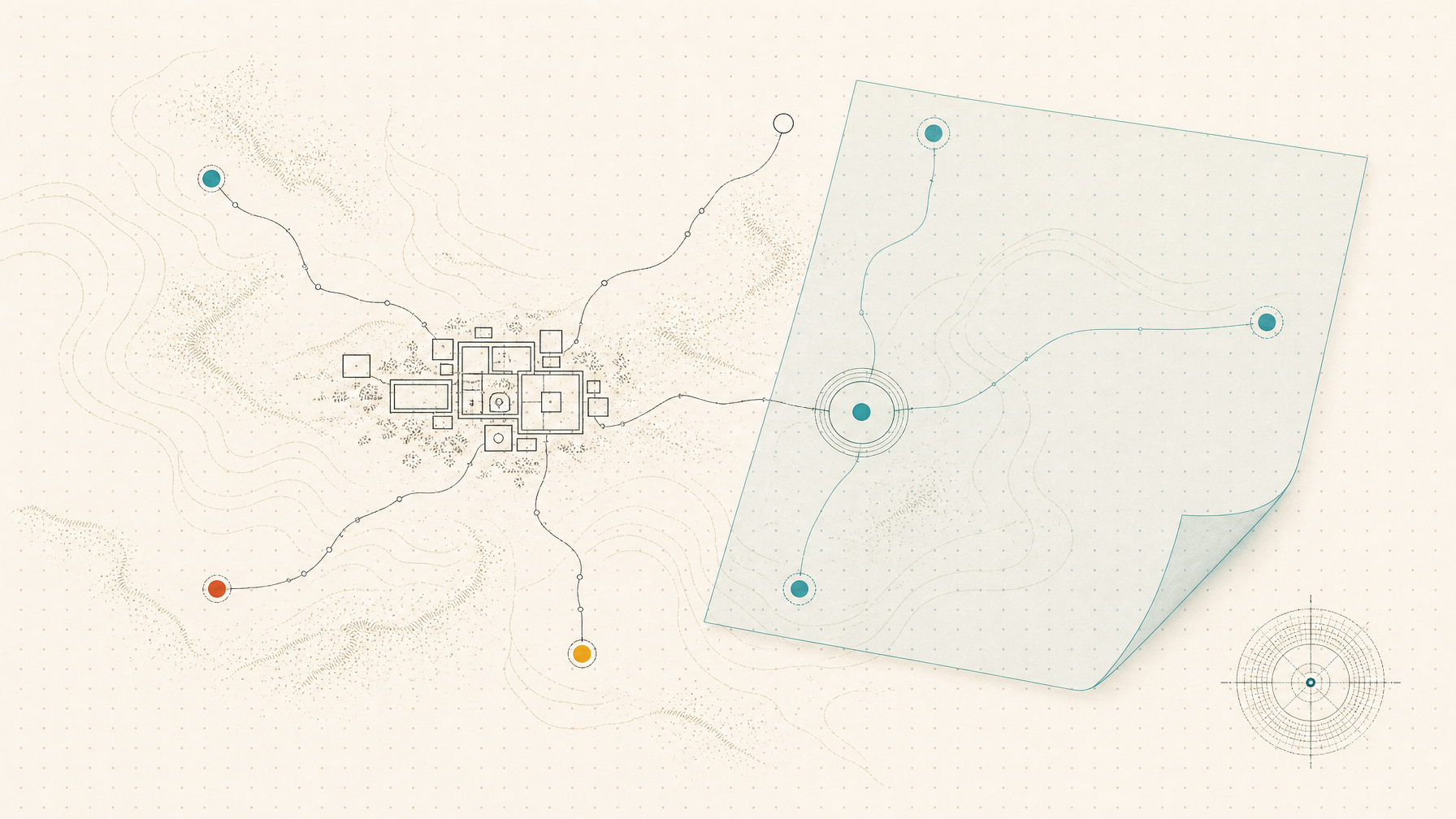
Collaboration OS is Iris Cocreative's operating layer for client work: one calm environment where the studio's clients, engagements, actions, meetings, and people live together as a navigable field. It replaces the old Airtable-and-Webflow portal, and it sits over ClickUp rather than replacing it — ClickUp remains the system of record for tasks, while the OS gives that data a spatial, legible, and client-shareable life.
Why It Exists
Three pressures made this build necessary:
- The old portal was structurally limited — a shared password instead of real accounts, no member-specific content, and interactivity bolted on through slow webhooks. These were foundation problems no amount of polish could fix.
- Generic work tools don't fit the work. The research beneath this project (Design Research) found a category defined by configuration fatigue — dashboards nobody opens, color that means nothing, forty data points where clients read four. The unoccupied position is exactly where this studio lives: live synced data + spatial arrangement + calm human judgment.
- Meetings, relationships, and knowledge deserve to compound. Every call the studio holds already becomes a transcript, a summary, and tasks. The OS treats these artifacts as first-class objects that enrich a shared field over time, instead of documents that scroll away.
How It Works
One dataset, many lenses. ClickUp tasks sync into Supabase on a schedule (two-way — edits in the OS flow back). Clients, engagements, and people were migrated in from the old Airtable backend. On top of this substrate sits the view-model engine: a view model is a small, human-readable definition file that says how to arrange entities — by list and status, by timeline, by assignee, by initiative — without ever writing positions into the data. New views are authored, not programmed; the format passed its "bus factor" test when a second person wrote one unaided.
Meetings become artifacts, artifacts become actions. Fireflies records and transcribes; an n8n automation matches each transcript to its planned meeting, writes a summary grounded in the team's own notes, files the artifact under the right engagement, generates its banner image, and creates the follow-up tasks in ClickUp — which then sync back into the field. Meetings can now be planned in the OS before they happen, so context flows forward instead of being reconstructed afterward.
Two products, one database. The team sees the full field; clients get invited accounts and a deliberately reduced view — task names, honest Action Process statuses, due dates, groupings — with no team chrome and nothing leaked by accident. The client view is designed to need no explanation.
A visual language, not a style. Color is reserved for status and time; shape, icon, and position carry everything else. The first component of this language — the action itself, rendered at five sizes from a dot on a timeline to a room you can enter — is prototyped live in The Action.
Where It Stands
Foundations, data plumbing, and the view-model engine are complete and verified against real client data. Client views and interface polish are in progress, and the artifacts pipeline is mid-evolution — planned meetings shipped, essence-first artifact pages and publish-to-field next. The full sequence lives in the Build Plan.
Where It Points
The design horizon is a genuinely spatial field — engagements as territory, meetings and actions as connected points, optional 3D where a third axis earns its place — grounded in the Design Considerations and, further out, the memory layer carried forward from the original Iris OS vision: features and lessons that compound across projects, so the studio's tenth community map is scoped with the knowledge of the first nine.